General notes on Fungi & Lichen images:
I really do love fungi, and why not, seriously? Where would we be without them? Sober, that’s where, and good luck with that. Thank you Saccharomyces cerevisiae, you have been, and continue to be, a loyal friend!
Apart from dividing these images into four sections, Ascomycetes, Basidiomycetes, the synthetic group Lichens, and the totally unrelated Myxogastria (aka Slime molds), no more taxonomy will appear here. It does my head in, besides I currently don’t have enough pictures to make further subdivision worthwhile. Besides, they’re cute. Just look at them, and not fuss over names. Those of you who know your fungi will be able to tell I am no field mycologist, so where I give any names they are generally little more than wild stabs in the dark. No doubt for some asinine legal crap I should also add a disclaimer. So I probably must advise you never to eat any fungi, under any circumstances, never, not even once. Just don’t.
Photographing fungi is somewhat different proposition to animals, esp. birds. Never has a mushroom run-away, or flown-off. Not yet anyway. There is just no need for concealment, or stealth, making it essentially ‘still-life’. This means the photographer is, for once, in total control, like a painter, essentially free to create the picture he/she wants. So there are no excuses for any bad ones! Oh, it’s also more relaxing, you get to lay down during the day, always a bonus, even if it’s wet, and things crawl up your bum.
Most of these pictures use the digital image ‘magic’ of focus-stacking, where a sequence of images, each with very slightly different focus-planes, are joined to create an image with great apparent depth of field. This mimics more what you perceive with the human eye. It is tricky magic, but when you do it correctly it can be amazing, revealing not just the subject, but it’s milieu, in great detail. It is also common to use ancillary light sources, some woods are so dark, that without this, capturing 100 focus-slices would take all-day. This makes it very like studio photography, except the laying in the mud bit, where you adjust the brightness, angles and even colour of various light sources, to create the modelling you want. I usually carry a pair of small led lamps and a filter set for that purpose. Note to future self, make this one of the first technique sections.
Another thing, given the nature of the subject’s environment, it is often necessary to remove odd twigs and other bits of detritus from around a fungi to make it more visible. This is usually called ‘gardening’ and, where I've done it, I make no apology. It harms nothing. I can’t move the subject as you can with a human model, and who wants a picture with a branch across it’s face. If this offends you, look away! If you want pictures of mushrooms hidden under leaves or covered in sticks, crisp packets and old KFC or McKrap cups take your own ! I do tho’ draw the limit at ADDING anything to a scene, that is a contrivance too far, so no props. not even a Grecian urn!
One final note: Equipment for bird photography is heavy. Equipment for fungi photography is heavy. 2x heavy is 2 much for me to carry miles at my advancing age. So usually I go out to do one or the other. This inevitable means I see the most beautiful fungi when I’m armed for birds. It is a sad reality. Soooo, a number of fungi here have been photographed used a mobile phone. I know that is simply execrable, posting picture from a phone on the web, and I will rectify it asap. In the meantime ‘needs must’, as some of them are nice.
BASIDIOMYCETES
The normal state of affairs for multi-cellular fungi, of course, is a complex feeding network (mycelium) of extremely fine hyphae, sometimes visible as a white web when you break the bark off a dead tree for example. Of course it’s the larger above-surface spore-dispersal structures, the commonly called mushrooms and toadstools, that give us such alien looking beauty. The ‘typical’ capped mushroom (the sort we have with stilton, garlic and white wine sauce on sourdough toast, yum, yum) belong to the Basidiomycetes (although not all are capped – but please don’t get me started!)
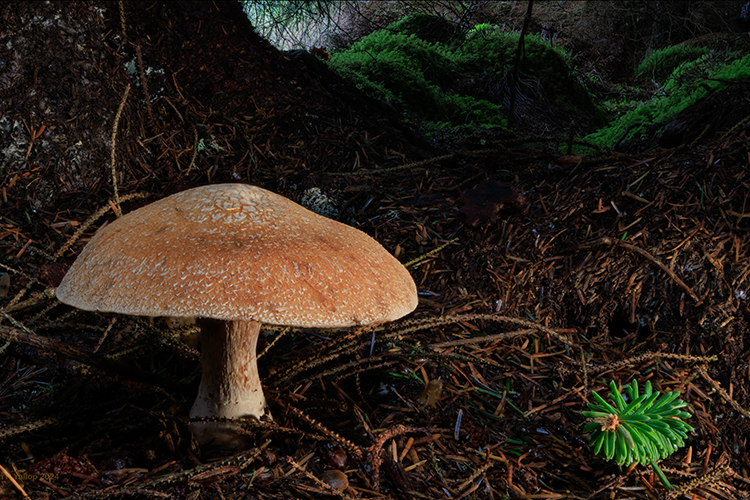
‘big boy'
I simply have no idea who this is, regrettably a common theme with many of the fungi here. It could be a species of Agaricus, but there again, it probably isn't. Either way, I came across him skulking in the darkest gloom of dense conifer plantation, and he just looked lovely. Asking if he minded me imposing upon his time, he told that he’d probably be gone in a few days and wouldn’t mind at all being immortalised. So, camera, tripod, lights! I wished I’d asked his name. RIP whoever you were. At about 140-160mm across he got the working name ‘big boy’, it will remain until somebody tells me what his name really was.
Photographically, I’ve taken the focus-stacking to the ‘max’ here, giving an in-focus background out to many metres. Whilst this doesn’t isolate the mushroom much, I do like it because I feel it shows him in his ‘home’ nicely, as it would appear to the human eye. For those unfamiliar with the technique this is not ‘fake’ background ‘montaged’ in with Photoshop, it was right there when the shutter was released, all 43 times! And no those fresh green pieces of twig weren’t added, what do you take me for?
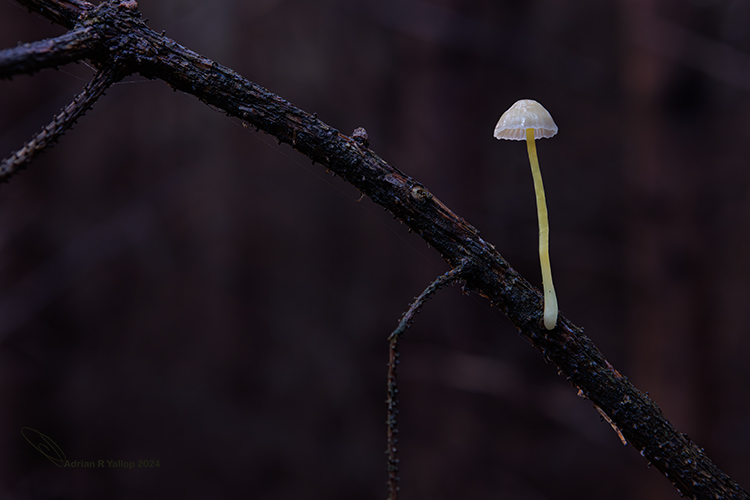
Mycena epipterygia
If I had to pick one fungus picture that I really like, I think it’s this one, and I nearly walked past it. Usually on fungi outings it’s eyes down, and this beautiful delicate little chap was growing on a twig about 5 feet above the ground. Once I’d asked him to stand still and walked around him once or twice to get the best light and background, I took a limited focus stack of about 20 images. During processing I actually used only 10 of those because that gave the nicest amount of background blur.
Definitely up there in my favourite list anyway.
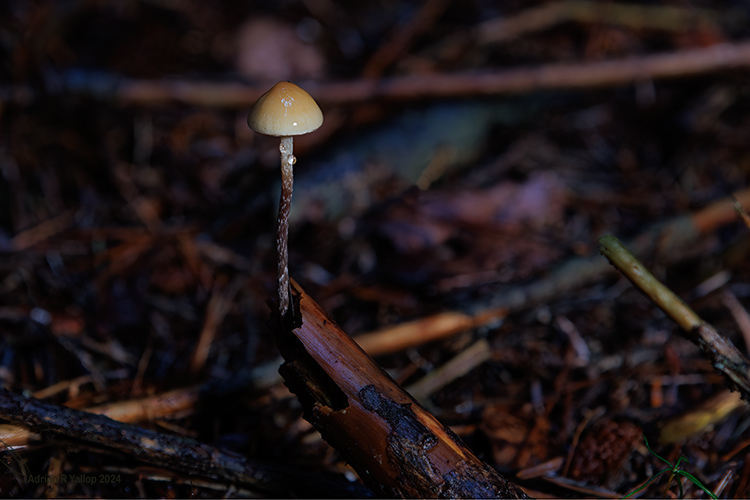
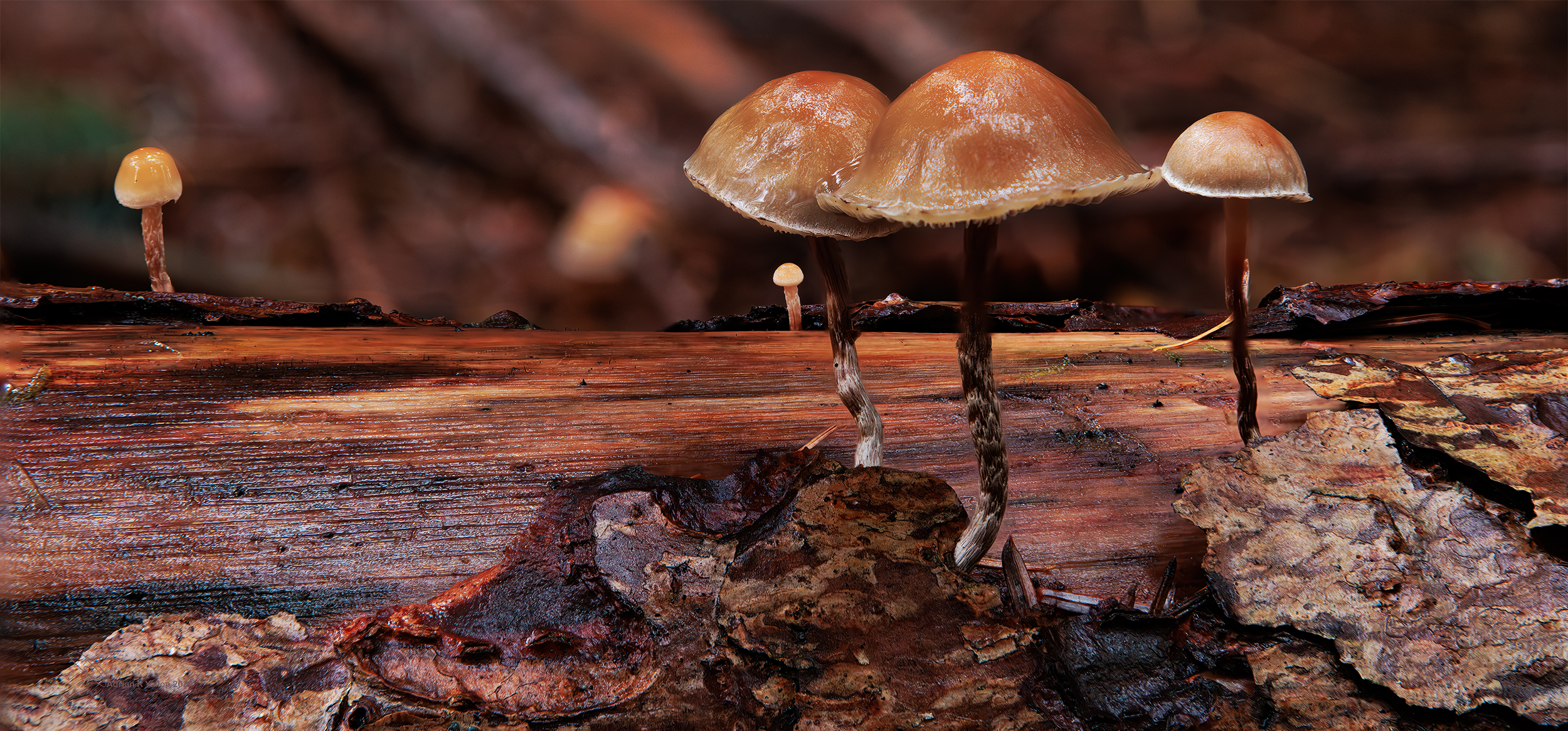
Hypholoma marginatum Snakeskin brownie
As I said all my IDs are really guesswork. Pro tem, until someone tells me better, I’ve decided this little chap is H. marginatum, most characteristics fit, esp. that stipe patterning (stem for the non-cognoscente). I think that is also the reason for the common name of ‘Snakeskin brownie’. It looks to be a fresh example, probably only popped up in the past day ot two, just for me. I am lucky.
Photographically I like this chap as much as the Mycena above. The focus stack in this case was limited in number and restricted to the fungi and foreground alone as I wanted to isolate the subject i.e show detail of the stick from which it grew without letting the it get ‘lost’ into the background if that was sharp too. see the thought that goes into these .... and it costs you nothing!
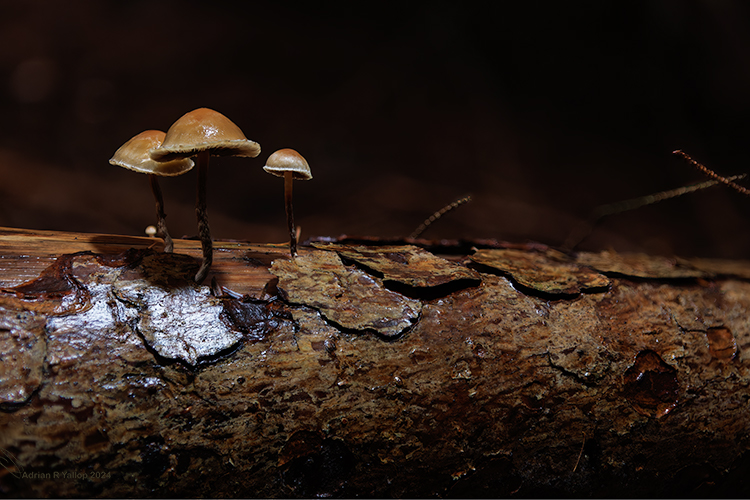
Hypholoma marginatum Snakeskin brownie: family portrait
On a visit about a week prior to catching the chap above I had found a little ‘family’ group of what I now think are also H. marginatum although the matriarchs were older and slightly pass their ‘best before’ date. For this first shot I tried low light and to try and create an intimate feel, maybe it worked. I Just wish the specimens were a tad younger and in better ‘nick’, but I feel that looking in the mirror every day as well.
I do like the little baby, just poking his head over edge of the log. It might have been a good idea to watch how this little group developed over time, but sadly I couldn’t find the site again. It’s harder than you might think in a dense conifer woodland.
Hypholoma marginatum, family portrait: take 2
Like all family portraits it’s a good idea to get a couple of takes. Changing lighting, image angle and number ‘focus-stacked’, has produced a completely different scene. As I said earlier, with this sort of macro work, you can pretty much create what you want.
Thing is, despite the rich colour of the dead wood, and that we find out we have a typical family of five, with two parents, an adolescent, a younger child and a wee baby, I just don’t like the end result. What is more irritating is that I don't know why.
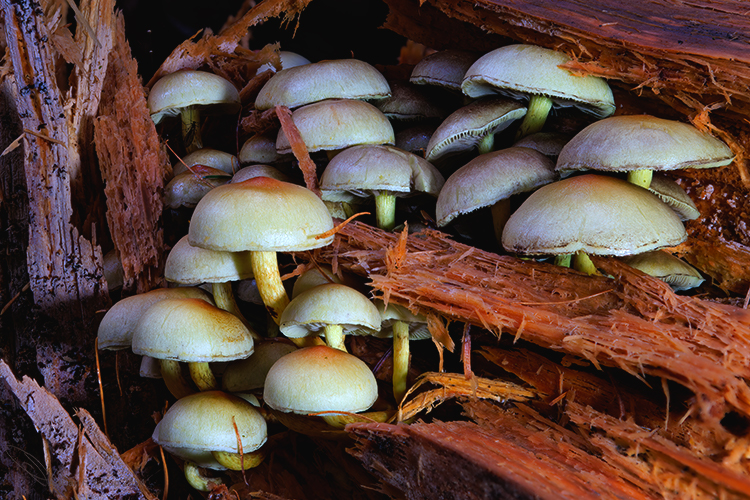
Hypholoma fasciculare
Sort of one of my favourite mushrooms, you always get such a dense troop of them. For many years we were lucky to have a family that used to reappear every year on some old logs in the garden.
They’ve moved on now, and have taken up residence in an old stump for last few years. One advantage of fungi over birds in the garden is they cost nothing to feed, except the odd log or stump, which reminds me we do need to put out some newly dead logs for them to move to soon.
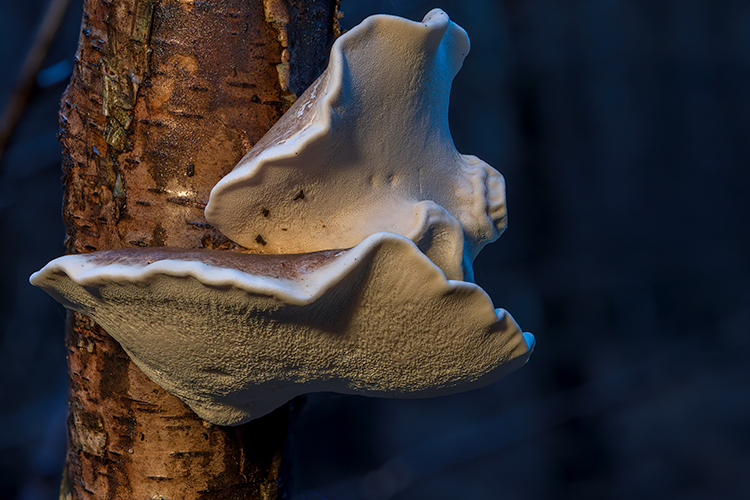
Fomitopsis betulina
Another walk into the forest, (un)fortunately no wolves or bears, or even beers, to distract me, although I suppose I could have put a bottle or two in the camera bag. Nope, instead I have a sensible flask full of hot water and a few teabags (Earl Grey of course). Only a short wander into the darkness and I find this big chap was right in front of my face. Good start. He doesn’t appear busy so I unload the tripod and rucsac from my shoulders and ponder the best angle for light and background. I choose a potential nice one, change the tripod from under-slung head for ground-lovers to the ‘right’ way up, set up lighting for under-illumination and we’re off. I capture a deep stack of over thirty images, in case I want to have background detail.
Once I’d taken a few sequences with slightly differing lighting, I sat on a log and made a cuppa. Beer would have been too cold.
I ultimately decided that a nice out-of-focus background provided the best setting for this lovely large polypore, so this result is from a stack of 14 to give full depth to Mr Fomitopsis and the birch, but leaving the rest in bokeh. Fortunately, it all turned out well. And if you don’t agree, go get your own.
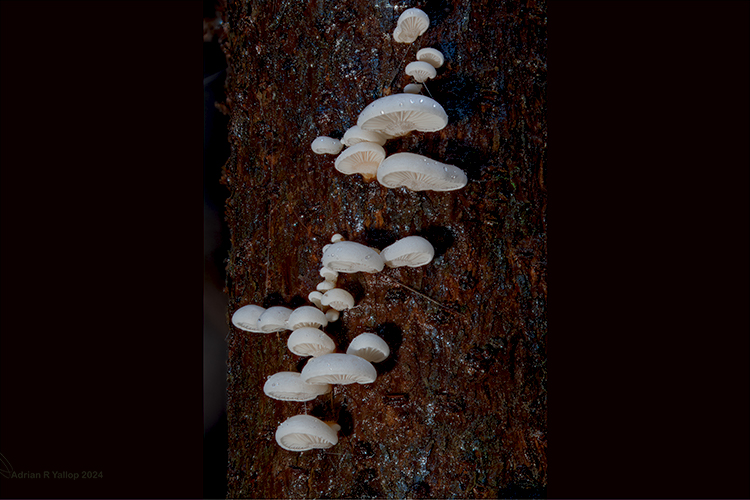
Panellus mitis ? Elastic oysterling
This family of delicate little …… well I was going to say flowers there, but that would be all wrong and, for all I know, probably insulting. OK these beautiful delicate little fungi, were hiding behind a fairly thin conifer of perhaps only 150mm diameter. The largest was only perhaps just about 20mm across so you can estimate the size of the tiniest, only a few mm, yet perfect.
Lighting these, it was pitch black in there, turned out to be problematic as they were pure white, everything else essentially black. They were also positioned at a difficult height, too low to bend comfortably which meant kneeling, but then you get all tangled up in the tripods legs, or the camera casts a shadow somewhere in the scene, Oh moan moan, I know, but it took nearly 50 mins, a cuppa and a roll-up to get set up for this image, I’m just sayin’! I know you all think it's a quick snap snap and go home.
In the end I think it paid off and this little family of dew covered Panellus mitis make a nice picture.
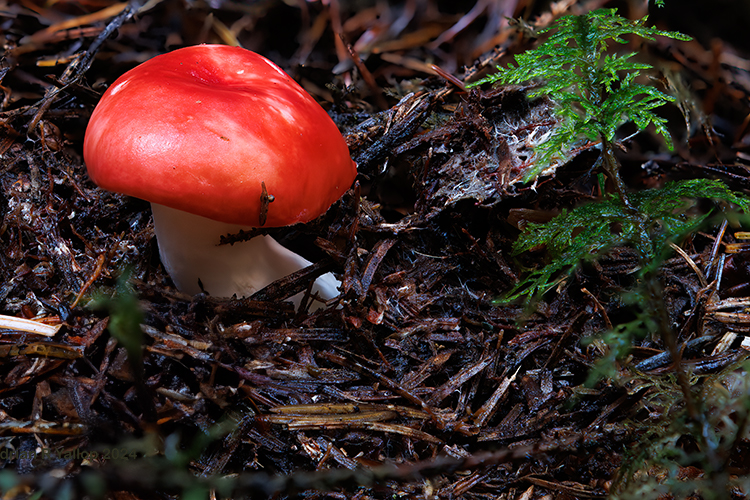
Russula emetica ? The Sickener
It’s been all subtle whites and browns so far in this little tour of fungi, so let’s bring a little colour in.
This still growing Russula does that in spades. It was growing in a small depression between two tree roots constraining the angle and elevation it could be photographed from somewhat. But it certainly didn’t lack in colour.
I think it’s emetica, tad hard to tell this early. In case both the Latin and English names still leave you wondering if it would be nice to eat, then it also used to be called the vomiting russula, possibly for the slow of wit.
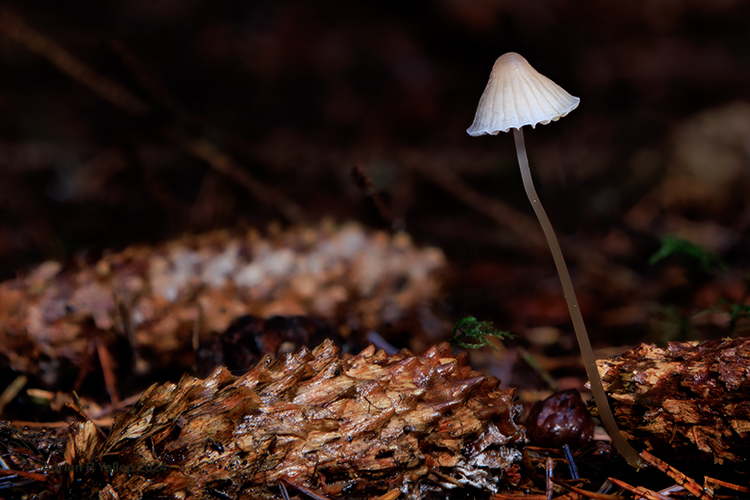
Mycena ?
This solitary little chap was hiding amongst the litter on the forest floor, again I completely forgot to ask his name. But he does look like a Mycena of some sort.
As he was so slight and delicate I decided to only use part of the image stack I’d taken so as to isolate him from a background of complex shades and colours. I also used relatively high light positions here so as to give a natural look. I think both work well enough here.
Oh, I don’t think they’re actually weetabix he’s living on, most likely immature spruce cones.
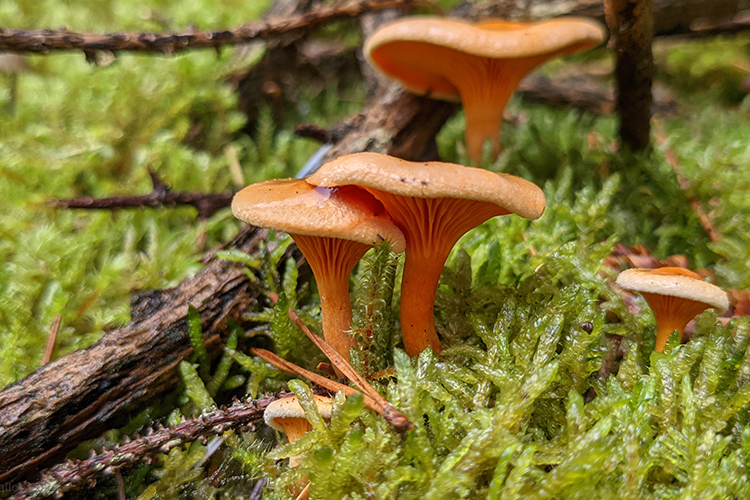
Hygrophoropsis aurantiaca False chanterelle
Well the first of a few ‘phone pictures. I am sorry but you do see nice things when you haven’t got the full kit with you, and you know they’ll be gone before you return.
This little group of H. aurantiaca were growing alongside the road, I just liked the setting and took this snap. Of course mobile phone cameras are total pants, over-relying on processing, esp over-use of sharpening and ‘vibrance’ manipulation to excess to try and create something just about bearable, on a tiny screen, from a tiny sensor.
Still I think the fungi are cute tho'!
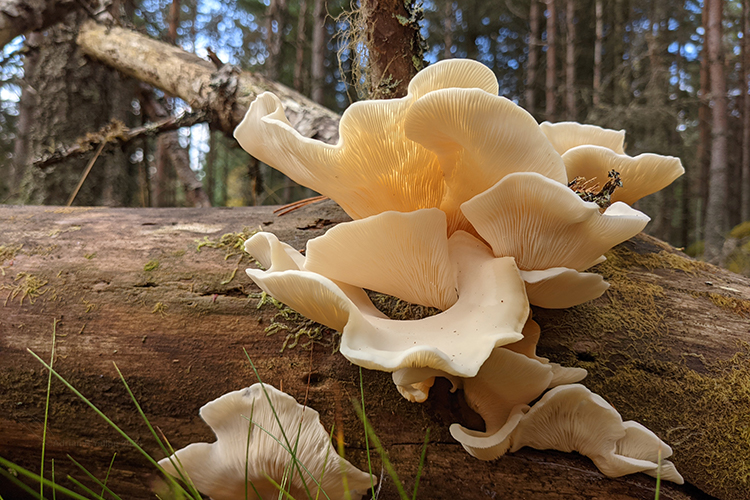
Pleurocybella porrigens ? Angel wing
Another phone picture. These just looked lovely – quite a display all along this dead log. I just had to get a picture or two, even dreadful ones.
I assumed at the start they were Pleurotus ostreatus or Oyster mushrooms, of course they might have been for all I know. However, they may also be Angel wings.
Both types seem to have once been considered edible, but there appears to be doubts now based the death of a few elderly Japanese. Now, I’m sort of elderly, but definitely not Japanese, so that may have given me a 50:50 chance! I didn’t eat them. Joking apart, I just don’t want to destroy something so lovely. They’re so transient I know, but it doesn’t ‘feel’ right somehow.
Amanita muscaria Fly Agaric
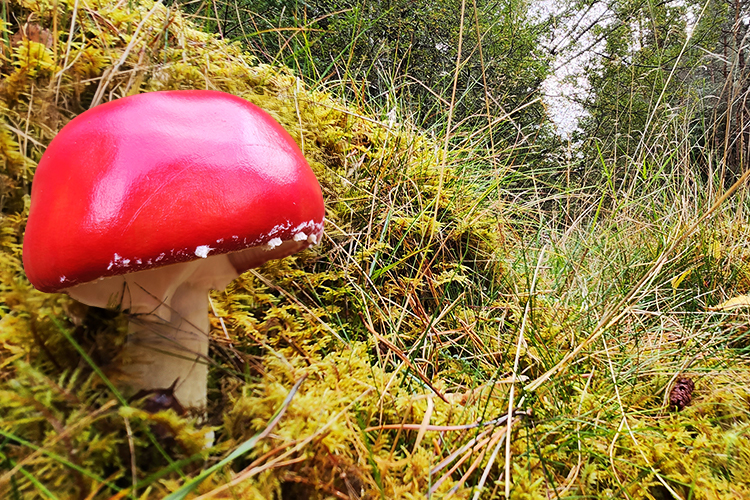
Another phone picture sadly: but a lovely new baby A. muscaria, what must be the most famous mushroom in popular culture. Almost certainly the one with the largest Wiki entry anyway!
The archetypal white spots of this species are formed by remnants of the veil (the membrane that surrounds and protects the developing mushroom). This example looks like it will be bald and shiny (reminds me of something), probably because it’s pushed its way through a thick carpet of wet Spagnum
Sometimes my bird pictures are accompanied by a little story, well this fungi comes with one. As you can tell from the image to get this picture I was laying in a dry(ish) ditch alongside a road. Well, as I was trying to get the angle I wanted, a car drove past. A moment later there is the screech of brakes, followed by the whine of reverse gear as it backs up to where I lay. It arrives and I see a very concerned lady looking at me through the passenger window. As I began to rise the look changes to shock, with a tad of horror mixed-in! I desperately try to explain that I was merely photographing a mushroom, and was not a run-over ex-person.
After a few moment it sinks in somewhat and with a much more relieved expression she drives off. Whoever you were, can I genuinely say sorry for alarming you.
The things that happen when I’m allowed out.
ASCOMYCETES
Well, of course, many Basidiomycetes are beautiful, but if we want to add a certain ‘alienness’ to that beauty we need to meet the Ascomycetes.
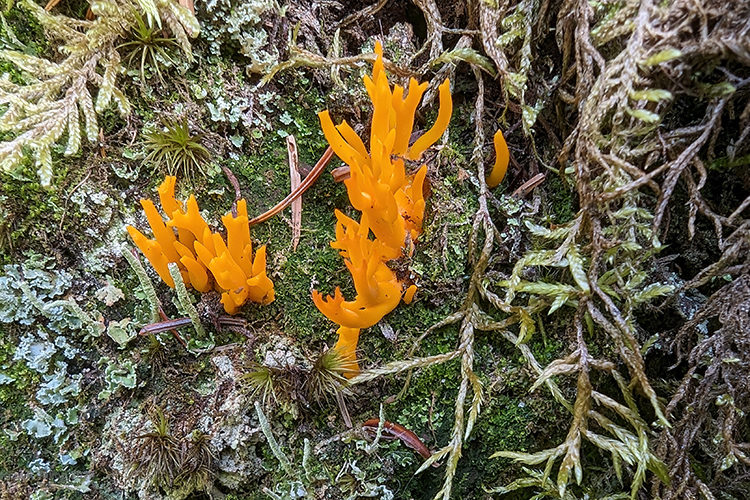
Calocera viscosa Yellow stagshorn
I really have to stop photographing birds so much and get back to the fungi. Because this phone image is the only picture I have of this group. So, pro tem I offer you a crap picture of a lovely Calocera just possibly viscosa. And that really does sound like it should be said in Hermione Granger’s voice doesn’t it.
LICHENS
Well if I have a soft spot for fungi, it certainly extends to their weird half-fungi half-biscuit half-algae compadres, the lichens. It is easy perhaps to consider them as a small and insignificant component of the landscape, yet they cover tens of thousands of square kilometres in many boreal zones. It is though their macroscopic mileu that draws me, that fractal component of our biosphere, of our actual existence, that most seldom bother to stop and look down ‘into’. Yet within an area as small as a few sq cms there is a whole other active three dimensional structure of life, a ‘city’ if you will of producers, consumers and yes parasites too. In addition to this inherently awe-inspiring intricate beauty of life, there is another big attraction to me, no politicians. None.
Lichenology and mycology are subjects that I really could, and indeed should, have spent more time on. Problem for me is they are far too often mired in taxonomy, rather than biology, and that’s a brain-deadener. How can you worry about a name when there’s the complex ecological mutualism between two completely different kingdoms to unravel?
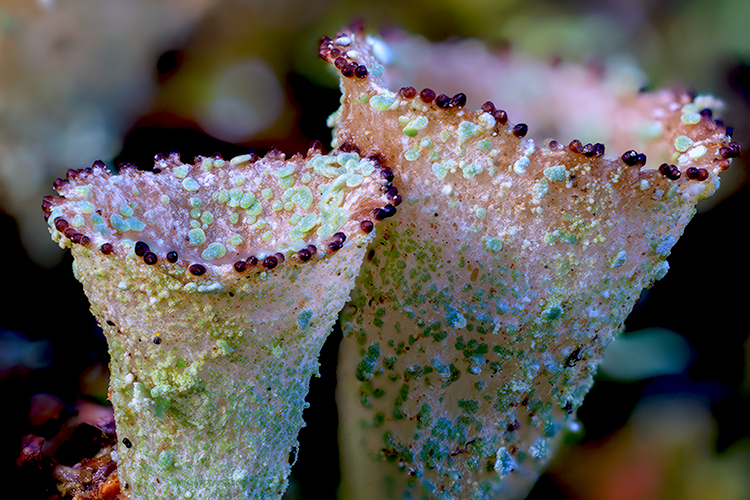
Cladonia fimbriata ? Trumpet cup
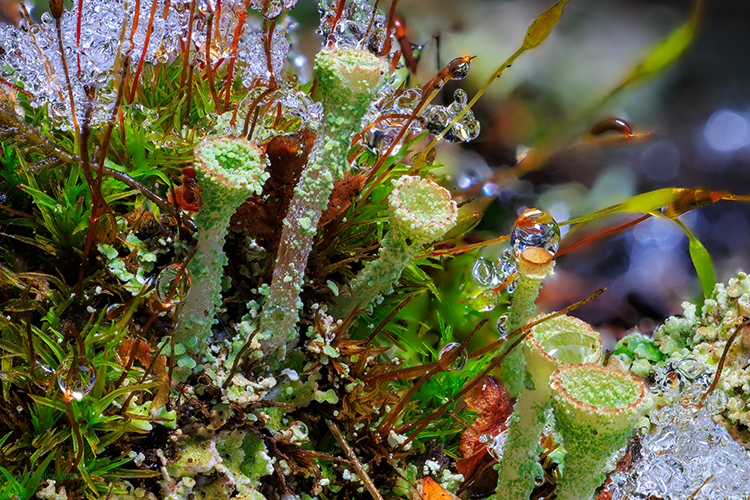
There’s been a hard frost overnight, and it’s still below freezing, but it’s a nice sunny day, beautiful. And I know where I, camera. lenses, tripod and lights are going. Yesterday, whilst loaded for birds, I stopped and looked down into a little frozen garden of mosses and lichens sitting atop a churchyard wall. I knew I had to come back and photograph it, and 24 hrs later I am here, setting up the tripod against the wall. It is a pain in the arse getting the lens close enough cos the tripod legs are in the way, then a bloody car wants to get past the other leg sticks out into the road, but you know every image comes with some moaning, right.
These vertical structures, perhaps the tower-blocks of our imagined macro-city, are known as podetia (podetium.sing.) a characteristic of Cladonia. The green discs covering this structure are soredia, composed of fungal hyphae and algal cells wrapped up together. These allow the dispersal of both partners together. Note they are not just produced within the ‘cup’ but can, and do, form elsewhere, as can be seen here.
One problem with these macro-worlds is knowing where exactly to look, or photograph, there are literally thousands of options for each m2. I pick one! Photographically this is captured with natural light as the day was quite bright, and some 68 very fine focus-slices were used.
Some of these, contain the asexual reproductive structures of the Ascomycetes fungal partner (remember the ‘alien’ quip above)
Cladonia fimbriata ? Trumpet cup
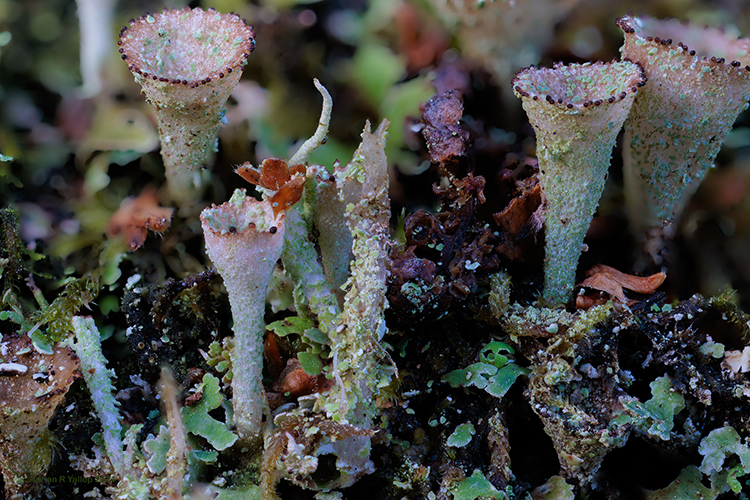
A week-is later I see some nice Cladonia growing on a sloping rock surface about 2 feet from a barbed wire fence. This will be a real bugger to try and photograph I think, to get the camera, tripod and me into that space without ripping clothes. Excellent, it will give me something to moan about!
Actually the reason I wanted to be wedged in here was that these specimens were showing lovely pycnidia, the dark-red structures ringing the top of the cupped podetia. These structures produce asexual spores of the fungal partner alone. We could go more into the biology here but that has to be enough new words for one day.
MYXOMYCETES
If Fungi and Lichens give me taxonomic headaches the Myxomycetes, colloquially part of the ‘slime molds’ (a pretty useless term) cause a full-on exploding head. The Myxo’s are deeply interesting, well to a biologist/ecologist (me, and mebbe just me), part of their life cycle is an active plasmodium (a mobile multinucleated single cell that may cover an area measured in m2, truly alien weird right. There’s more to life than things that run around on their hind legs making a lot of noise and shitting-up the place. They also have a static phase, the bits I’ve photographed here. Anyway, enough of all that.
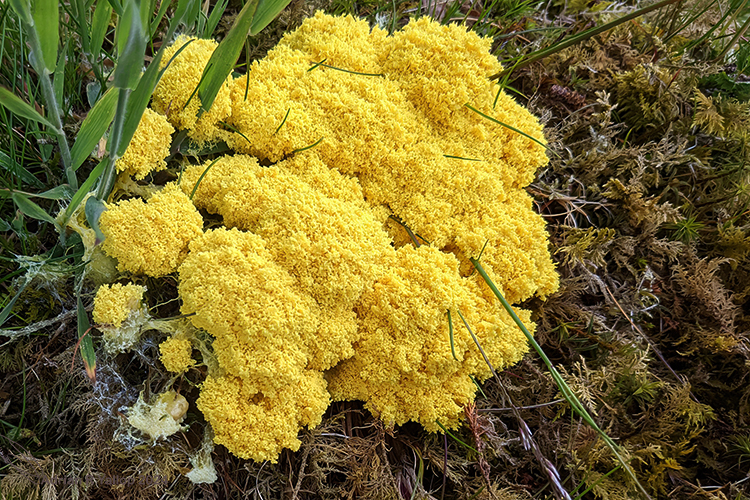
Fuligo septica ? Dog's vomit
I prefer, let’s face it who doesn’t, the alternate common name of Scrambled-egg slime mold! Which indeed it does look like. I don’t have a dog but if I did, and it puked this up, I suspect I’d be looking under the kitchen table for the remains of the custard powder tub.
Taken with a phone sadly, these things don’t last in this form for long so it was a case of take, it or lose it.
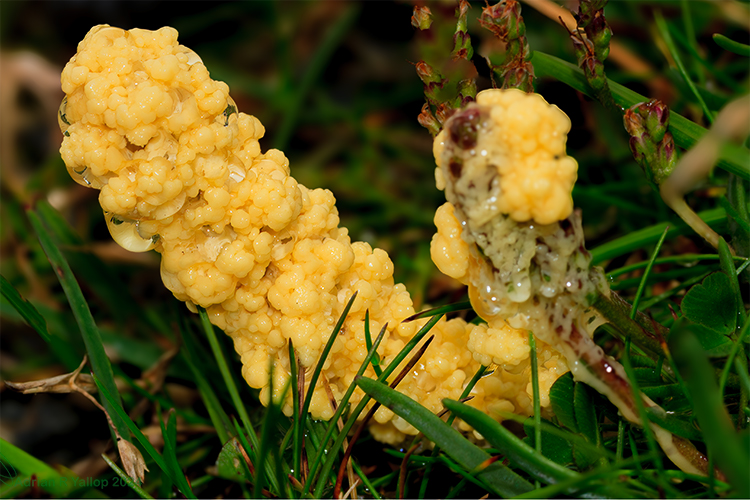
Didymium spongiosum ? Dog's sick slime mold
Well I have no idea where those that named butterfly or birds were when it came to naming slime molds. I mean no ‘Camberwell Beauties’ or ‘Golden Orioles’ here, just versions of dog puke. Seriously guys.
Anyway this chap drew my attention walking through Weisdale, so I took his picture. Regrettably it was before things like focus-stacking. A record shot no more.
And no, for the last time, I didn't just make this name up after reading Harry Potter, of course I am now wondering what the incantation (cue Hermione Granger's voice) "Didmium spongiosum" would actually do, sounds as though it might make your .................
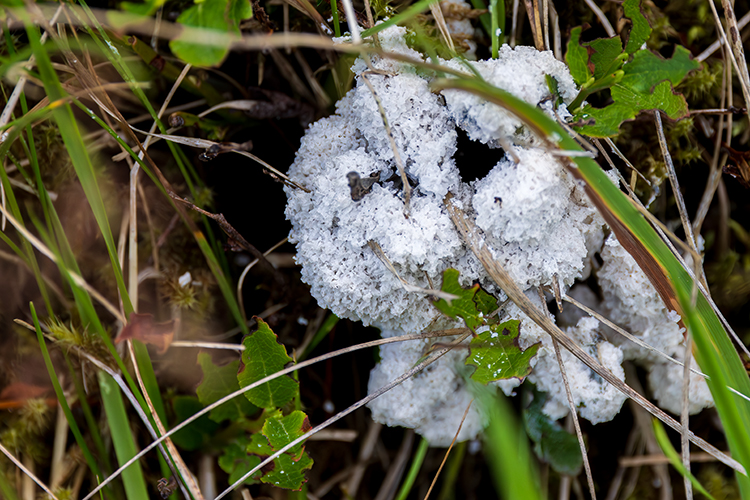
Didymium spongiosum ? Dog's sick slime mold
A decade or so later and I come across his Scottish cousin (Shetland isn’t Scottish-just ask them!). Although I was lucky to have the real camera with me when I spotted this chap behind a wire fence I did not have a tripod with me, so the focus-slice thing couldn’t be done, hence the narrow focus zone. I was also carrying a long lens – so had to stand back somewhat!
Now as I said slime mold taxonomy is a hopeless mess, and probably only tractable with any reliability using genetic approaches. Now I think might be Didymium spongiosum but it might be another F.septica or mebbe a dog with digestive issues just passed with way.